Innovative Product Ideas Test (IPIT)
Testing several product or service ideas and finding out which one will be most successful with your consumers is possible!
The Innovative Product Ideas Test lets you identify winning concepts from a pool of product or service ideas by evaluating them with your end consumer. With its Choice Based methodology you can measure appeal, trial intent, innovation, brand alignment and relevance with a fast, low-cost method and no limit on the number of concepts to evaluate.

- Indicators included
- 16
- Analysis blocks
- 6
- Add-on modules
- 3
- Depth
- Detailed
What does it solve?
- Gain visibility into the concepts that will succeed in the market
- Learn which of your innovations has the highest acceptance for each profile of interest
- Launch with more agile processes and greater certainty
- Improve your company's innovation timing and processes
- Reduce costs from low-success launches
- Minimize brand positioning risks from unsuccessful launches
Who is this study for?
What's included?
The analyses and indicators delivered in your report.
01Comparative concept performance
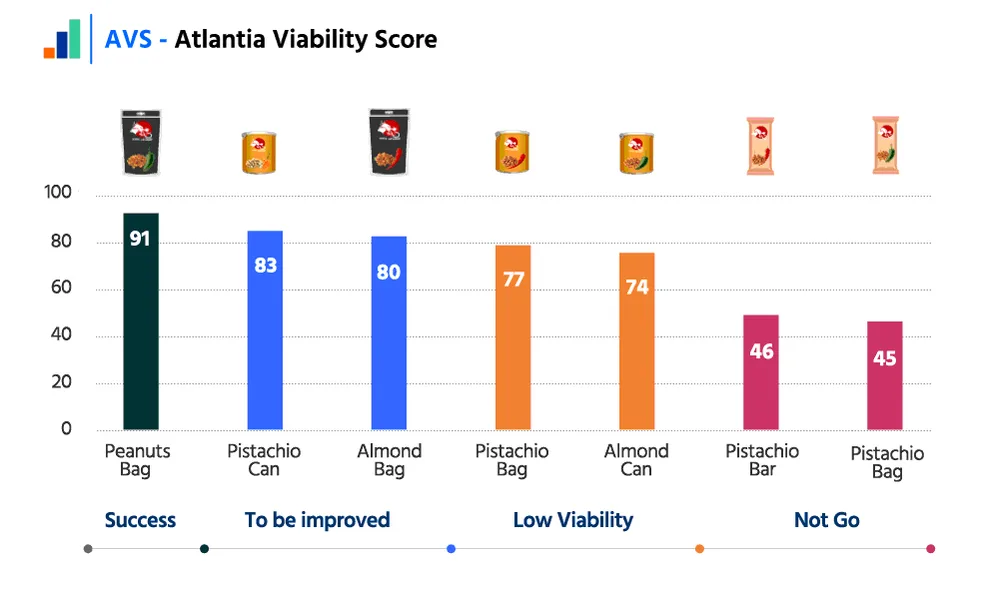
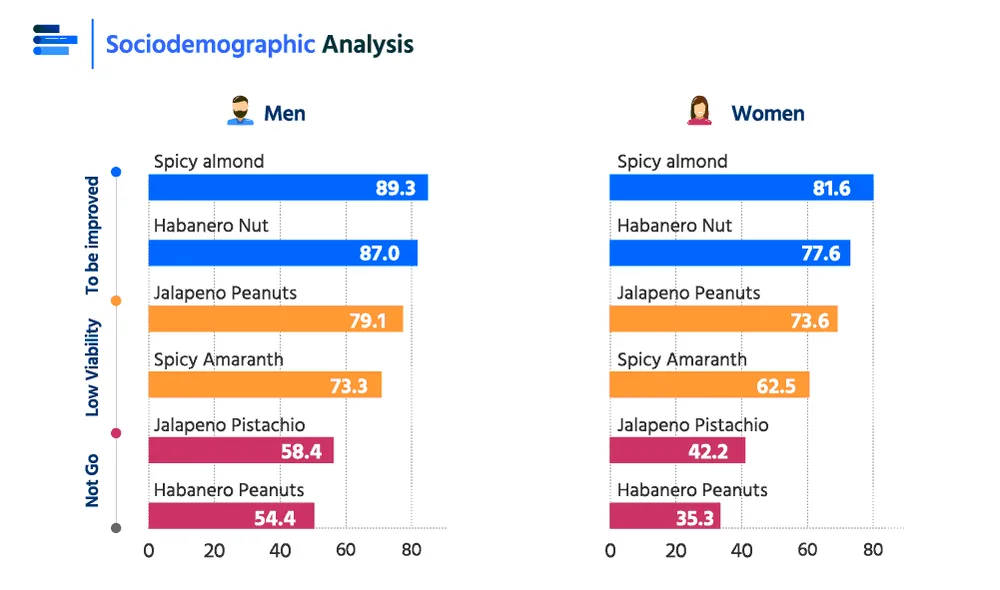
AVS (Atlantia Viability Score) is an indicator of product development feasibility. It takes into account the market preference obtained by each product (normed with the option “None of the above”) and the variables: appeal, innovation, consumer relevance, brand fit and trial.
Based on the final score, products fall into one of the following zones:
- Success: +90
- To be improved: 90 / 80
- Low viability: 80 / 60
- AVS (Atlantia Viability Score)
02Disruption Quadrant (innovation vs. relevance)
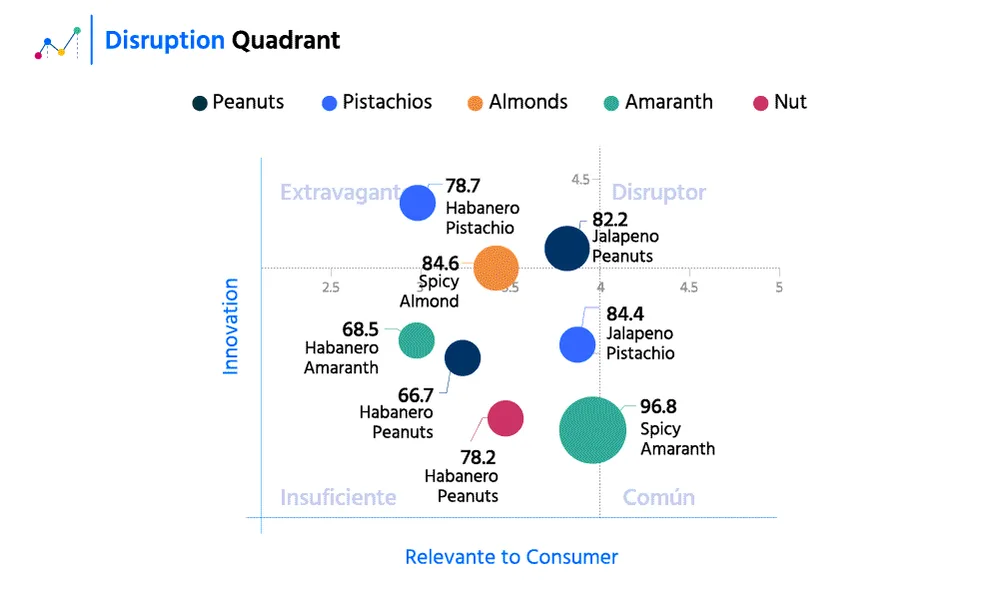
Determines how innovative a proposal is in relation to what is relevant to the consumer. This analysis naturally sorts products into four regions:
- Disruptor: innovative proposals that are relevant to the consumer.
- Extravagant: innovative proposals that do not resonate with the consumer.
- Common: proposals that meet a consumer need within the ordinary.
- Lacking: proposals that are not relevant to the consumer and fall into the ordinary.
03Portfolio Fit Quadrant (brand fit vs. trial intent)
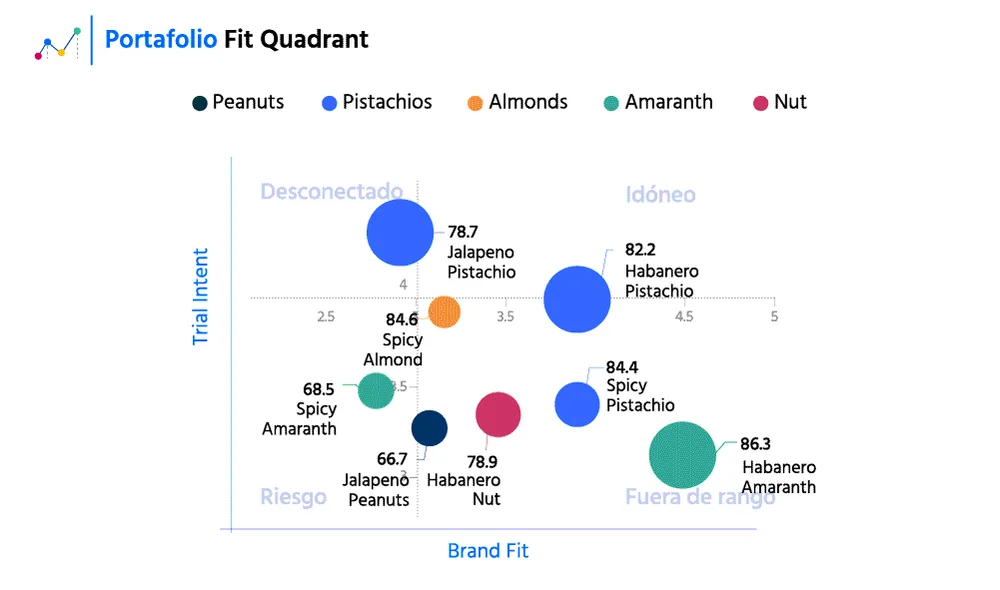
Determines how aligned a proposal is with the brand in relation to the consumer's trial intent. This analysis naturally sorts products into four regions:
- Ideal: proposals aligned with the brand that generate trial intent.
- Redefinition: proposals aligned with the brand that lack trial intent and need different communication.
- Out of range: proposals poorly aligned with the brand that do generate trial intent.
- Risk: proposals poorly aligned with the brand and lacking trial intent.
04Individual concept performance
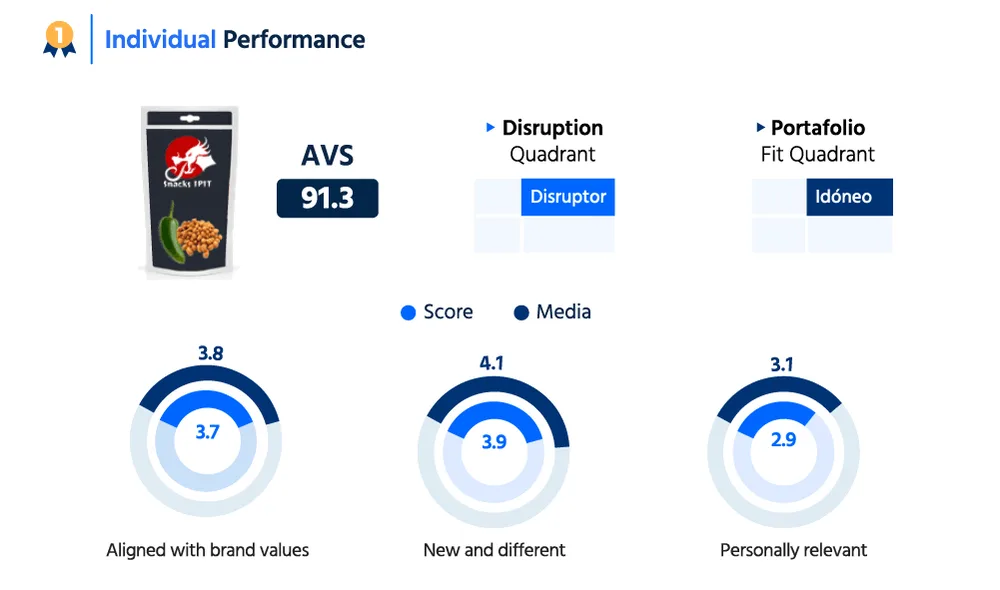
- AVS Viability Score
- Trial Intent Score
- Brand Fit Score
- Relevance Score
- Innovation Score
- Most attractive elements (MAE)
- Least attractive elements (LAE)
- Likeness Score
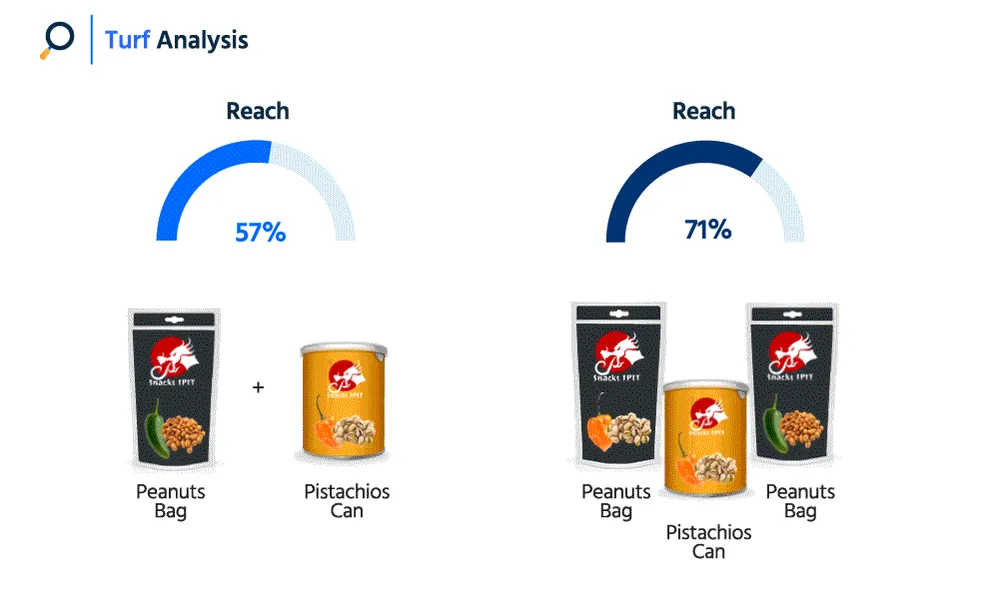
05Incrementality analysis (TURF Analysis)
Identifies market reach when you want to build a pipeline of products to develop. Using Total Unduplicated Reach and Frequency analysis, we identify the combination of products that achieves the greatest market reach.
- Market reach (2 products)
- Market reach (3 products)
- Market reach (4 products)
06Sociodemographic analysis
- Analysis by age
- Analysis by gender
- Analysis by socioeconomic level
- Analysis by region
Add-on modules
Extend your study with these optional modules.
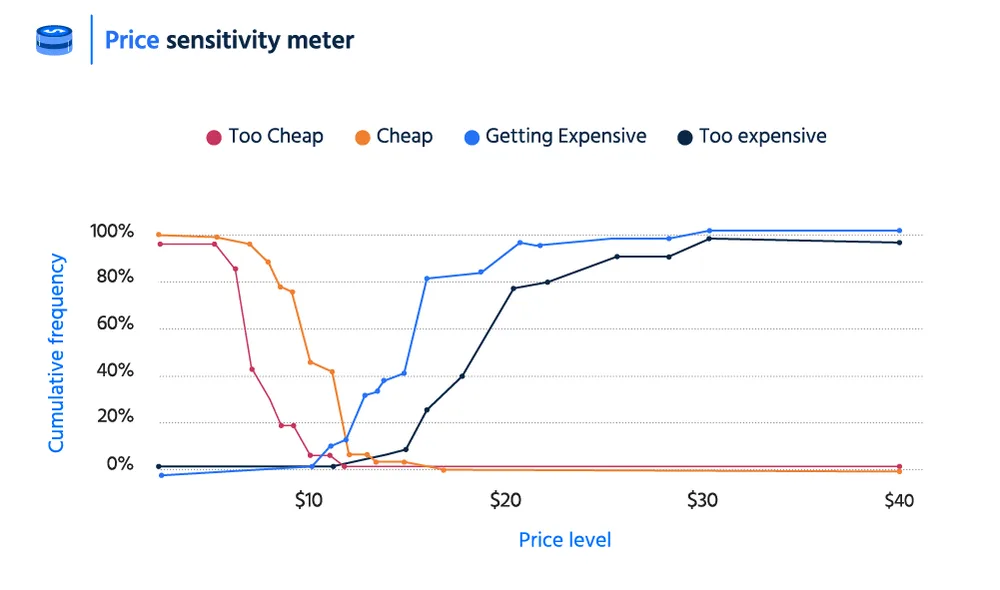
Price Sensitivity Meter (Van Westendorp) and NMS
- Optimal price point (OPP)
- Indifference price point (IPP)
- Point of marginal cheapness (PMC)
- Point of marginal expensiveness (PME)
- Price elasticity chart
- Revenue vs. price chart
Source of Volume
- Incremental volume
- Volume from your category
- Volume from other categories
- Volume by brand
Share distribution analysis (Shapley Value)
- Real (non-incremental) contribution per product
- Market reach (2 products)
- Market reach (3 products)
- Market reach (4 products)
Methodology
Atlantia's methodology for evaluating concepts uses Choice Based algorithms, a statistical technique that measures the value consumers associate with a product idea. Each concept is evaluated against other alternatives, generating scenarios and obtaining specific indicators on the preference and appeal of each product.
The data is analyzed in terms of preference, appeal, purchase intent and differentiation to calculate a viability score (Atlantia Viability Score, AVS). A TURF analysis is also run to measure the market reach generated by the product ideas. Because the methodology is 100% automated, the experimental design is generated in seconds and can go to field in minutes.
See how it works in this video.
Want to apply Innovative Product Ideas Test (IPIT) to your brand?
Talk to our team and let's design the study you need together.
Frequently asked questions
What is Innovative Product Ideas Test (IPIT)?
Testing several product or service ideas and finding out which one will be most successful with your consumers is possible! The Innovative Product Ideas Test lets you identify winning concepts from a pool of product or service ideas by evaluating them with your end consumer. With its Choice Based methodology you can measure appeal, trial intent, innovation, brand alignment and relevance with a fast, low-cost method and no limit on the number of concepts to evaluate.
What does Innovative Product Ideas Test (IPIT) solve?
Gain visibility into the concepts that will succeed in the market. Learn which of your innovations has the highest acceptance for each profile of interest. Launch with more agile processes and greater certainty. Improve your company's innovation timing and processes. Reduce costs from low-success launches. Minimize brand positioning risks from unsuccessful launches.
What does the Innovative Product Ideas Test (IPIT) study include?
It includes Comparative concept performance, Disruption Quadrant (innovation vs. relevance), Portfolio Fit Quadrant (brand fit vs. trial intent), Individual concept performance, Incrementality analysis (TURF Analysis) and Sociodemographic analysis. You can also add optional modules: Price Sensitivity Meter (Van Westendorp) and NMS, Source of Volume and Share distribution analysis (Shapley Value).
What methodology does Innovative Product Ideas Test (IPIT) use?
Atlantia's methodology for evaluating concepts uses Choice Based algorithms, a statistical technique that measures the value consumers associate with a product idea. Each concept is evaluated against other alternatives, generating scenarios and obtaining specific indicators on the preference and appeal of each product. The data is analyzed in terms of preference, appeal, purchase intent and differentiation to calculate a viability score (Atlantia Viability Score, AVS). A TURF analysis is also run to measure the market reach generated by the product ideas. Because the methodology is 100% automated, the experimental design is generated in seconds and can go to field in minutes.
Who is Innovative Product Ideas Test (IPIT) for?
It is designed for Market research, Consumer Insights, Research & development, Innovation, Category management, Product managers and heads of product and Marketing teams.
Other solutions you may like

Innovation Pipeline Analysis & Simulation (IPAS)
Choose the innovations with the highest potential: evaluate concepts against competitors and consumer preferences, and simulate their share and cannibalization.
View solution →
Packaging Test
Find the packaging design with the greatest potential for success: Atlantia Packaging Score, heatmaps, brand fit, price sensitivity and shelf standout.
View solution →
Price & Portfolio Strategy Simulator (P&POSS)
Build a data-driven pricing strategy: simulate competitive preference-share scenarios and find the optimal configuration of up to 150 SKUs.
View solution →